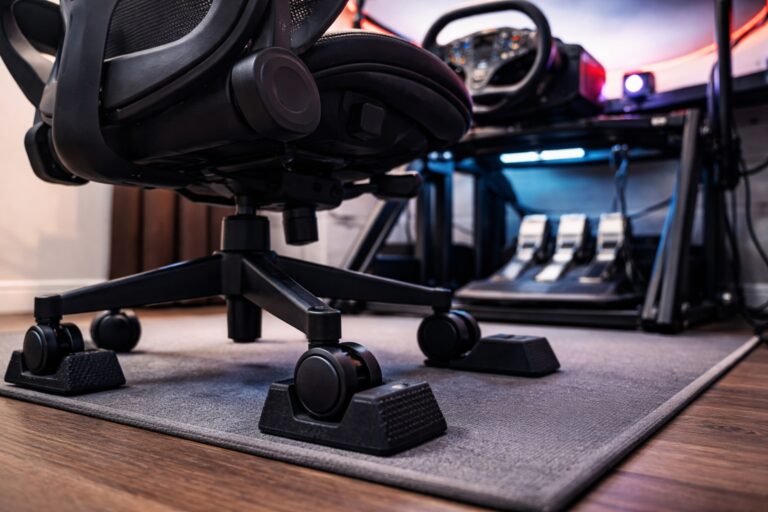
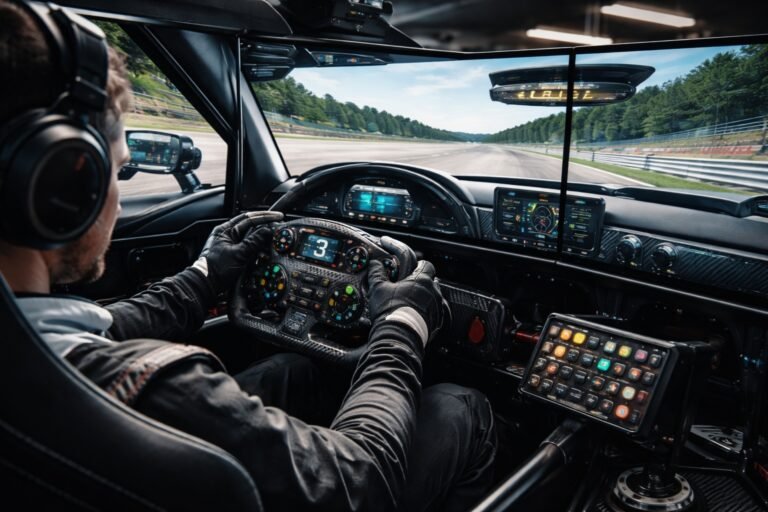
Yes, sim racing helps with real driving, but the answer depends entirely on what type of driving you’re talking about. For learning race circuits and developing track skills, modern simulators deliver measurable value. For everyday street driving, the benefits exist but remain limited, and the risk of transferring bad habits is real. The gap between virtual laps and actual asphalt is narrower than ever, yet some fundamental differences will never disappear.
What Actually Transfers from Sim to Reality
Track Awareness and Racing Line Theory
Understanding the optimal racing line through a corner translates directly from simulator to reality. When you’ve spent 50 laps finding the perfect apex at Spa’s Eau Rouge in iRacing, that spatial knowledge carries over when you arrive at the actual circuit. Your brain has already mapped the trajectory, the braking markers, the corner camber changes.
This applies to anyone doing track days or amateur racing. The geometry of a fast lap remains consistent whether you’re holding a plastic wheel or a real steering column. You learn to identify the widest entry point, hit the geometric apex, and maximize exit speed using all available track width.
For street driving, this knowledge matters far less. Public roads don’t reward carrying maximum speed through a decreasing radius corner. The racing line theory that saves tenths on a circuit becomes mostly irrelevant in traffic.
Visual Processing and Anticipation
Simulators force you to process visual information quickly. In a 30-car iRacing lobby at Monza’s first chicane, you’re scanning three cars ahead, monitoring your mirrors, anticipating sudden braking. This heightened visual processing becomes automatic after hundreds of race starts.
That skill transfers to real-world traffic awareness. Your peripheral vision develops, you start predicting lane changes before they happen, you notice brake lights further ahead than most drivers. Highway merging becomes easier because you’ve trained your brain to track multiple moving objects simultaneously.
The limitation appears in depth perception. Even with VR headsets, your brain knows the screen distance. Judging the exact gap to the car ahead when merging at 130 km/h on an autoroute requires real-world calibration that no simulator provides perfectly.
Smooth Inputs and Weight Transfer Understanding
Assetto Corsa Competizione punishes jerky steering inputs and aggressive throttle application. You learn that smooth, progressive pedal pressure produces faster lap times than stabbing the brake. This understanding of weight transfer, the way a car’s balance shifts under acceleration and braking, absolutely transfers to reality.
When you brake progressively, loading the front tires gradually, you maintain more grip. When you unwind the steering smoothly on corner exit, you can apply power earlier. These principles work identically in a real GT3 car or a street Honda Civic.
The danger emerges when sim racers transfer racing intensity to public roads. Smooth inputs are valuable. Trail braking into a roundabout at the absolute limit is dangerous and illegal. The technique transfers, but the context where you apply it must change completely.
Mental Pressure Management
Sim racing creates genuine pressure. Leading a 90-minute iRacing endurance race, maintaining concentration while managing fuel strategy and tire degradation, demands mental endurance. You make split-second decisions about overtaking attempts, defend position against faster opponents, stay focused when fatigue creeps in.
This mental training has value for real racing. Professional drivers use simulators specifically for this mental conditioning. The ability to maintain focus over long stints, to make decisions under pressure, to stay calm when a competitor dives inside you, these elements transfer effectively.
The missing component is physical fear. Crashing in iRacing costs you rating points. Crashing at 200 km/h on a real circuit could cost you your life. That fundamental difference means sim racing develops mental skills but cannot replicate the complete psychological experience of real racing.
The Critical Differences You Can’t Simulate
Physical Feedback and G-Forces
Your body provides zero information about lateral G-forces while sim racing. When you take Blanchimont flat-out in a simulator, your backside stays planted in a stationary chair. In reality, 4G lateral forces pin you against the seat, your neck muscles strain, your vision narrows slightly.
This absence of physical feedback forces sim racers to rely entirely on visual cues and force feedback steering. You compensate by listening to tire scrub, watching for visual slide, feeling steering resistance. These skills have value, but they’re substitute signals, not the real thing.
The result is that many fast sim racers feel disoriented during their first real laps. The physical sensations overwhelm the visual learning. Your brain spent months calibrating to visual-only inputs, now it must recalibrate to include powerful physical sensations. This adaptation typically requires several real-world sessions.
Real-World Risk Assessment
The restart button doesn’t exist in reality. This obvious truth creates a subtle psychological problem: sim racing can erode appropriate risk assessment. When you’ve restarted 1,000 races after first-corner incidents, your brain’s threat detection becomes calibrated to virtual consequences.
Some sim racers report driving too aggressively on real roads immediately after long practice sessions. The mental state that rewards maximum commitment at every corner doesn’t switch off instantly. You need active recalibration, conscious acknowledgment that the rules have changed.
Professional racing drivers manage this mental transition constantly. They understand when to activate race mode and when to drive normally. Amateur sim racers sometimes lack this context switching ability, especially younger drivers who learned in simulators before experiencing real high-speed driving.
Sensory Input Gap
Even the best force feedback wheel provides simplified information compared to real steering. You don’t feel the subtle vibrations from different road surfaces, the way steering weight changes over bumps, the feedback differences between cold and hot tires.
Triple-screen setups improve peripheral vision compared to single monitors, but they still can’t match natural human vision. You lose the instinctive ability to glance at your mirror without turning your head, the subtle depth perception that helps judge closing speeds.
VR headsets solve some visual problems while creating others. Depth perception improves dramatically, immersion increases, but resolution limitations mean you can’t read dashboard displays as clearly. Most importantly, you still can’t feel the car moving beneath you.
The Professional Evidence: What Top Drivers Say
Max Verstappen and Lando Norris both compete in online sim racing regularly, crediting it with maintaining their racecraft between real events. Verstappen specifically mentions that rapid decision-making in sim racing keeps his reactions sharp.
Scott Mansell, professional racing driver and coach, tested the Mazda MX-5 back-to-back in iRacing versus reality after 26,000 miles coaching in the real car. His verdict: the well-developed sim version requires nearly identical driving inputs and technique. The physics match closely enough that his real-world driving style works in the simulator without modification.
Formula 1 teams use sophisticated simulators for development work and driver preparation. These professional-grade systems cost millions, feature motion platforms, and use proprietary tire models. They validate the core principle: modern simulation technology can replicate vehicle dynamics accurately enough to produce real-world performance improvement.
The caveat remains consistent across professional testimonials: simulators work best for drivers who already have real-world experience. They supplement and maintain skills more effectively than they create skills from scratch.
For Track Driving: High Value
Circuit Learning Without Track Time Costs
Laser-scanned circuits in iRacing and Assetto Corsa Competizione reproduce track surfaces accurate to millimeters. Every bump, every camber change, every rumble strip exists in the correct location. You can learn Spa-Francorchamps or Circuit de Barcelona-Catalunya without spending thousands on track rental.
This represents genuine value for track day enthusiasts and amateur racers. You arrive at the circuit with the layout memorized, braking zones identified, corner speeds estimated. Your first real lap won’t be spent figuring out where the track goes.
The time-to-pace advantage is measurable. Drivers who practice circuits in simulators reach competitive pace 30-40% faster than those learning from scratch on arrival. That’s fewer sessions spent orientation, more sessions refining technique and setup.
Race Craft Development
Wheel-to-wheel racing teaches spatial awareness that no solo practice session can provide. Learning to defend the inside line, judge overtaking opportunities, manage traffic in mixed-class racing, these skills develop through repetition against human opponents.
iRacing’s safety rating system encourages clean racing. Unlike arcade games where contact is inconsequential, iRacing penalizes incidents. This creates behavior patterns closer to real racing: patience, precision, respect for other competitors’ space.
The limitation appears in physical risk assessment. You’ll attempt an optimistic dive-bomb move in iRacing that you’d never risk in reality. The physics might be accurate, but your decision-making calibrates to virtual consequences. Translate that directly to real racing and you’ll cause expensive crashes.
For Street Driving: Limited but Real
Where It Helps
Emergency maneuver practice has legitimate value. If you’ve experienced oversteer repeatedly in simulation, practiced counter-steering corrections, your muscle memory exists when unexpected real-world oversteer occurs. The response won’t feel completely foreign.
Hazard perception at highway speeds improves through sim racing. Your brain learns to process the road ahead at 140 km/h, track multiple vehicles, anticipate sudden situations. This translates to better awareness during motorway driving.
Understanding vehicle dynamics helps you drive smoother. Progressive throttle application, gentle steering inputs, these habits from sim racing reduce tire wear and improve passenger comfort in real cars. The fundamental techniques remain valid even at street speeds.
Where It Doesn’t
Simulators don’t teach parking, low-speed maneuvering, or traffic navigation. You won’t learn to judge your car’s width in tight spaces or estimate stopping distance at 30 km/h in a school zone. These everyday driving skills require real-world practice.
Risk tolerance calibration differs completely. Racing simulators reward maximum commitment and calculated risk-taking. Street driving requires conservative risk assessment and prioritizing safety margins. These opposing mindsets don’t coexist naturally.
Traffic rules versus racing rules create another disconnect. Sim racing teaches you to use every centimeter of track width, brake as late as physically possible, accelerate at maximum attack. These behaviors are inappropriate and illegal on public roads.
The Transition Warning
Expect a recalibration period during your first real laps after heavy sim sessions. Your inputs will feel different, the sensory information will overwhelm initially, your risk assessment will need conscious adjustment. This adaptation typically requires 15-20 minutes of real driving to stabilize.
The adrenaline response differs dramatically. Virtual racing elevates heart rate and creates competitive tension, but actual speed in a real car produces a different physiological response. Some drivers feel the speed more intensely than expected, others feel underwhelmed by normal road speeds after racing virtually at 300 km/h.
Respect real-world physics absolutely. Sim racing teaches correct techniques, but real crashes cause real injuries. Never assume your virtual experience guarantees real-world competence. Professional instruction, gradual progression, and humble acknowledgment of simulation’s limitations remain essential.
How to Use Sim Racing for Real-World Improvement
Choose the Right Simulator
iRacing, Assetto Corsa Competizione, and rFactor 2 prioritize realistic physics over accessibility. These simulators punish unrealistic driving and reward proper technique. If skill transfer is your goal, avoid arcade-style racers completely.
Force feedback steering wheel systems are mandatory for useful practice. Entry-level options like the Logitech G29 or Thrustmaster T300 provide adequate feedback. Direct drive wheels offer superior detail but cost significantly more. Pedals with load-cell brakes improve muscle memory for threshold braking.
VR headsets deliver the best immersion and depth perception. Triple-monitor setups provide acceptable peripheral vision at lower cost. Single-screen setups limit your ability to develop proper visual scanning habits. Invest in display quality if you’re serious about skill transfer.
Practice with Intent
Focus on consistency rather than outright speed. Repeat the same corner 50 times trying to brake at the exact same point, hit the same apex, achieve identical exit speeds. This repetition builds muscle memory that transfers to reality.
Study your telemetry data, particularly brake pressure application. Smooth, progressive brake curves indicate good technique. Sudden pressure spikes suggest you’re brake-stabbing. Work deliberately on eliminating input harshness rather than chasing lap time records.
Practice traffic awareness in race situations, not just solo hotlapping. Learn to anticipate other drivers, manage mixed-speed traffic, develop spatial awareness under pressure. These skills transfer more readily than ultimate one-lap pace.
Complement with Real Experience
Use simulators for repetition and track learning, but validate everything with real driving. Book track days to experience actual speed, take professional driving instruction to confirm your techniques translate correctly, approach real driving with appropriate humility.
Never replace actual driving instruction with sim practice alone. Professional instructors provide feedback on subtleties that simulators can’t teach: how your body position affects control, how to scan the road effectively, how to manage risk appropriately for the context.
Consider simulators as repetition tools rather than primary training. The value comes from practicing correct techniques hundreds of times more cheaply than real track time allows. But those techniques must be learned and validated in reality first.
The Verdict: Context Determines Value
For aspiring track drivers and amateur racers, modern simulators provide extraordinary value. The ability to practice circuits, develop racecraft, and refine technique at minimal cost accelerates real-world skill development measurably. Professional racing drivers validate this with their continued simulator use.
For improving everyday street driving safety, sim racing offers modest benefits with real limitations. Better visual awareness and smoother vehicle control transfer positively. But inappropriate risk tolerance, missing low-speed skills, and the absence of real consequences create potential negatives that outweigh positives for some drivers.
For learning specific circuits before track days, simulators are unmatched cost-effective tools. The price difference between 100 virtual laps and 100 real laps is massive, and the learning transfer justifies the investment completely.
For replacing real-world driving experience entirely, simulators fail. They supplement, enhance, and maintain skills effectively. They cannot create complete driver competency alone, and assuming they can leads to dangerous overconfidence.
Sim racing helps with real driving when you understand its role clearly: a supplement for deliberate practice, not a replacement for actual experience. Use it to multiply your track time, maintain sharpness between events, or learn circuits efficiently. Don’t use it as your only preparation for real high-speed driving, and never let virtual confidence override real-world caution. The technology has advanced remarkably, but physics, consequences, and human physiology remain irreplaceably real.