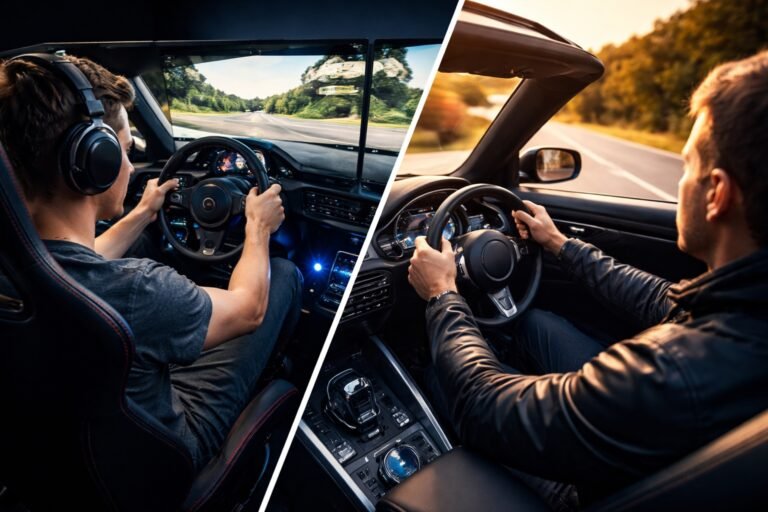
Sim racing reproduces real motorsport physics through software and hardware. Tire temperature affects grip, suspension geometry changes car behavior, and setup adjustments matter as much as driver input. After thousands of hours between real GT cars and virtual cockpits, the gap between simulation and reality has narrowed to the point where professional teams use the same tools you can access from home.
Sim Racing: Racing Simulation, Not Just Racing Games
The term simulation carries weight here. A racing game lets you drive fast cars with simplified physics designed for immediate fun. A racing simulator replicates the actual physics equations that govern vehicle dynamics.
Take Assetto Corsa Competizione versus Forza Horizon. In ACC, cold tires slide unpredictably for the first two laps. Brake too late into Eau Rouge and weight transfer sends you into the barrier, exactly like the real Spa circuit. Trail braking modulates front grip through the apex. In Forza Horizon, you drift through every corner at full throttle because the physics prioritize spectacle over accuracy.
iRacing laser-scans real circuits down to millimeter precision. Every bump, every kerb angle, every camber change exists in the virtual environment exactly as it does on tarmac. When drivers like Max Verstappen or Lando Norris practice on simulators before race weekends, they’re using the same track data and physics models available to anyone with a PC and subscription.
Telemetry separates simulation from gaming. Real race engineers analyze data traces showing brake pressure, steering angle, throttle input, and tire temperatures across every meter of track. Sim racing platforms provide identical telemetry. You can compare your brake point at Turn 1 Monza against reference laps, see where you’re losing time, adjust brake bias or anti-roll bars, and immediately test the changes.
What Makes a Sim Racer a Simulation
Physics and Tire Behavior
Tire physics drive everything. A race tire operates within a narrow temperature window, typically between 80-100°C depending on compound. Push too hard on cold rubber and grip vanishes. Overheat the fronts through aggressive steering and understeer develops mid-corner. Lock a wheel under braking and you flat-spot the tire, creating vibration that affects brake points for the rest of the stint.
Weight transfer determines grip at each corner of the car. Brake hard and load shifts forward, compressing front suspension and increasing front grip while lightening the rear. Turn in while braking and that rear instability helps rotate the car, a technique called trail braking. Lift off throttle mid-corner in a rear-engine car and sudden weight transfer can snap the rear around. These aren’t programmed special effects, they emerge from physics calculations running hundreds of times per second.
Real racing demands managing slip angles. The fastest way through a corner isn’t zero slip, it’s finding the optimal angle where the tire generates maximum lateral force before breaking traction. Sim racing replicates this. You feel the limit through force feedback, sense when the front tires transition from gripping to pushing, decide whether to back out or commit. Miss that window and lap time evaporates.
Car Setup and Adjustments
Every racing simulator worth the name lets you adjust the same parameters real race engineers manipulate. Suspension geometry affects weight transfer rates and mechanical grip. Stiffen the rear anti-roll bar and the car rotates more aggressively, but go too far and rear traction on exit suffers. Lower ride height reduces drag but can bottom out over kerbs, destroying your lap.
Aerodynamic balance matters in high-downforce cars. More rear wing adds stability through fast corners but kills straight-line speed. Front splitter angle affects understeer balance. Get the aero wrong at Monza and you’re three-tenths off the pace regardless of driving skill.
Brake bias distribution between front and rear changes how the car responds under braking. Too much rear bias and the rears lock early, destabilizing the car. Too much front and you can’t trail brake effectively. The optimal setting varies by circuit, car, tire compound, and even fuel load as weight distribution changes.
Professional sim racers spend as much time in setup menus as driving. The same applies to real motorsport. Setup isn’t optional at competitive levels.
Force Feedback and Immersion
Force feedback through the steering wheel communicates information, not just creates resistance. When the front tires approach their slip limit, you feel the wheel go light as the pneumatic trail shifts. Hit a kerb and you sense the suspension compressing through oscillations in the wheel. Lose rear grip and the wheel suddenly goes heavy as the front tires regain authority.
Entry-level wheels like the Logitech G29 use gear-driven motors. You get basic feedback but the gears introduce notchiness and delay. Belt-driven systems smooth this out. Direct drive wheelbases eliminate mechanical intermediaries entirely, connecting the motor directly to the steering shaft. The clarity of information increases exponentially. You feel tire slip earlier, catch slides faster, and read track surface changes that gear-driven systems can’t transmit.
This isn’t about realism for its own sake. Better feedback translates directly to faster lap times. When you can feel the front left tire beginning to push before visual cues appear, you adapt earlier and carry more speed. The difference between 5Nm and 15Nm of torque isn’t just stronger forces, it’s resolution of information.
Which Simulators Exist
PC Simulators
iRacing dominates competitive online racing. The subscription model funds continuous development, laser-scanning new tracks quarterly, and maintaining the most populated multiplayer service in sim racing. The Safety Rating system ensures clean racing by matching drivers of similar skill and racecraft. Official series run hourly with real-time matchmaking. Professional esports championships on iRacing offer six-figure prize pools.
Assetto Corsa Competizione specializes in GT3 and GT4 racing with official SRO licensing. The tire model captures GT3 behavior better than any competitor. Weather systems affect track temperature and grip dynamically. Night racing challenges visibility and concentration. ACC found its niche as the GT3 simulator, period.
Assetto Corsa (the original) trades specialized depth for breadth. The modding community has produced thousands of cars and tracks, from historic Formula One machinery to touge mountain roads. Want to drive a 1967 Ferrari 312 at the original Spa layout? AC makes it possible. The physics remain solid even if less refined than ACC.
rFactor 2 offers the most sophisticated tire model in sim racing, modeling carcass flex and temperature gradients across the contact patch. The learning curve is steep and the interface dated, but prototype and endurance racing communities appreciate the physics depth. Real teams use rFactor 2 Pro for driver training.
Le Mans Ultimate launched in early access with official WEC licensing. It aims to become the endurance racing reference, featuring Hypercar, LMP2, and LMGTE machinery with full day-night cycles and weather progression. Built on rFactor 2’s engine but modernized significantly.
Automobilista 2 and RaceRoom Racing Experience fill specialized niches. AMS2 excels in Brazilian stock car racing and vintage content. RaceRoom offers free-to-play entry with quality GT3 and touring car content, plus the official ADAC GT Masters license.
Console Options
Console sim racing has legitimized over the past five years. Assetto Corsa Competizione on PlayStation 5 and Xbox Series X/S now includes crossplay with PC, unifying the player base. The physics remain identical to PC, only visual fidelity takes a minor hit.
Gran Turismo 7 bridges simulation and accessibility better than any competitor. The tire model understands weight transfer and slip angles. Setup options give meaningful control over car behavior. The career mode introduces concepts progressively. GT7 serves as the ideal entry point before committing to PC hardware investment.
F1 24 and EA Sports WRC target specific motorsport disciplines. Both incorporate serious physics while maintaining approachability. F1’s handling model has evolved considerably, now requiring proper brake points and racing line awareness to compete online.
The Hardware You Actually Need
Entry Level
A Logitech G29 or G923 paired with the included pedals and a desk mount creates a functional sim racing setup for under $400. The force feedback communicates basic information about grip and track surface. The pedals lack load cells but provide sufficient feel to learn threshold braking.
You can run competitive lap times on entry hardware. The limitation isn’t the gear, it’s seat time and technique development. Drivers have won online championships using G29 wheels against competitors with $5000 direct drive rigs. Consistency matters more than equipment at this level.
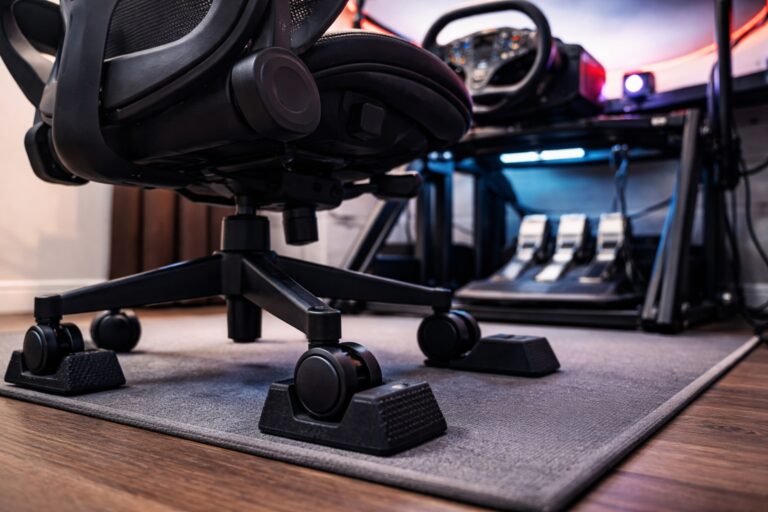
A proper racing rig improves the experience significantly, even a basic one. Rigid mounting prevents the wheel flexing under force feedback loads. Stable pedal mounting means you can brake harder without pushing the base across the floor. Proper seating position reduces fatigue during longer races. Expect $200-400 for an entry aluminum profile rig.
Mid-Range Setup
Between $500-1500, you enter the range where hardware genuinely enhances performance. Load cell brake pedals transform braking precision. Instead of measuring pedal travel like potentiometer-based systems, load cells measure pressure. You brake by feel rather than position, exactly like real cars. Muscle memory develops faster and transfers better.
Belt-driven wheelbases from Thrustmaster or Fanatec deliver smoother force feedback than gear-driven alternatives. More importantly, they provide higher torque output, typically 5-8Nm versus 2-3Nm for entry wheels. This increased strength communicates more detail and allows for faster corrections.
A dedicated rig becomes mandatory. The increased forces from better hardware will destroy desk mounts. Aluminum profile rigs offer adjustability and rigidity. Invest here before chasing high-end peripherals.
High-End Territory
Direct drive wheelbases start around $600 and scale to $2000+ for professional-grade systems. The jump from belt-driven to direct drive creates the single largest improvement in feedback quality. Tire slip becomes obvious before it appears visually. You catch slides earlier because you feel them developing, not after they’ve started.
Premium pedals with hydraulic dampers replicate actual brake feel with uncanny accuracy. Simucube, VRS, and Heusinkveld represent the current state of the art. Expect $1000-2000 for a complete pedal set at this level.
Motion systems add another dimension but prioritize them last. A quality motion rig costs $3000-15000. The information gain doesn’t justify the investment unless you’ve maximized every other component. Professional drivers use static rigs for training because visual and steering feedback matter more than motion cues.
How Sim Racing Connects to Real Motorsport
Formula 1 teams run factory simulators using software and physics models derived from the same commercial platforms available publicly. Mercedes, Red Bull, and Ferrari maintain simulator facilities where drivers accumulate hundreds of hours annually. They learn circuits, test setup directions, and maintain racecraft between events.
The FIA has integrated sim racing into motorsport’s official structure. The Formula E World Championship includes official sim racing events. GT World Challenge, WEC, and national touring car series all sanction esports competitions. Prize money reaches six figures in top-tier events.
Real drivers transitioning to simulators face minimal adaptation. Max Verstappen regularly streams iRacing races, competing against sim specialists and holding his own. The racing line, brake points, and car control fundamentals transfer directly. What doesn’t translate: g-forces, cockpit heat, and physical fatigue.
The reverse transition, sim to real racing, produces legitimate success stories. Jann Mardenborough won GT Academy on Gran Turismo, then competed in GP3, LMP2, and Super GT. William Byron started on iRacing, reached NASCAR, and won at Cup Series level. James Baldwin went from online ACC to becoming a professional GT3 driver with McLaren Customer Racing. The skills transfer isn’t marketing, it’s documented repeatedly.
Understand the limitations though. Sim racing teaches racecraft, brake points, and car control. It doesn’t prepare you for sustained 4g lateral loads, 60°C cockpit temperatures, or the consequence of real danger. Physical fitness requirements differ entirely. But the mental skills, spatial awareness, and technical knowledge? Those carry over completely.
Getting Started: First Steps
Choose your simulator based on what interests you. Want wheel-to-wheel GT3 racing? Start with Assetto Corsa Competizione. Prefer variety and modding? Assetto Corsa original. Serious about online competition? iRacing despite the subscription cost. Console-bound? Gran Turismo 7 offers the smoothest learning curve.
Start with entry-level hardware. A Logitech G29 or Thrustmaster T248 teaches fundamentals without massive financial commitment. You’ll understand what matters in force feedback and pedal feel before upgrading becomes worthwhile. Drivers waste thousands buying high-end gear before developing the skill to exploit it.
Learn one track deeply before exploring the catalog. Pick something iconic with good flow, Spa-Francorchamps or Brands Hatch. Run 50 laps focusing purely on consistency, not speed. Memorize every brake marker, every apex, every shift point. Consistent 2:22s beat erratic 2:19s followed by offs into barriers.
Join online communities early. The SimGrid aggregates leagues across multiple platforms. iRacing forums contain setup databases and technique discussions. Discord servers for specific simulators connect you with drivers at every level. Racing solo against AI teaches car control but not racecraft. You need to race humans to develop overtaking judgment, defensive positioning, and spatial awareness.
Common Beginner Mistakes
Buying too much hardware too quickly wastes money. A $2000 direct drive base won’t make you faster if you haven’t learned weight transfer or optimal racing line. The equipment’s capability exceeds your ability to use it. Buy entry gear, develop skill, identify specific limitations, then upgrade deliberately.
Jumping into online races unprepared destroys Safety Rating and frustrates everyone involved. Run 100 offline laps before entering multiplayer. Learn to keep the car on track consistently. Understand flag rules and basic racecraft. Other drivers deserve competitors who won’t punt them off at Turn 1.
Ignoring setup basics limits improvement. You don’t need to become a setup engineer immediately, but understanding that lowering tire pressure increases grip, or that brake bias affects rotation, prevents you from fighting against the car needlessly. Most simulators include baseline setups that work reasonably well. Start there, drive 20 laps, then make one small change and test again.
Chasing the fastest drivers creates frustration without learning. Find reference lap times one second quicker than your current pace, not three seconds. Analyze where that driver brakes, how they approach corner entry, where they position the car. Bridge gaps incrementally rather than attempting heroic leaps that end in barriers.
The Reality Behind the Screen
Sim racing offers genuine motorsport immersion accessible from home. The learning curve exists because the physics are real, not simplified. The progression from first wobbly laps to competitive pace creates satisfaction that arcade games can’t replicate. The barrier to entry has never been lower, and the ceiling extends all the way to professional esports careers and real racing opportunities.